A showcase of the winning feature film of 2024.
NYCTOPHOBIA, 88min., USA
Directed by Seayoon Jeong
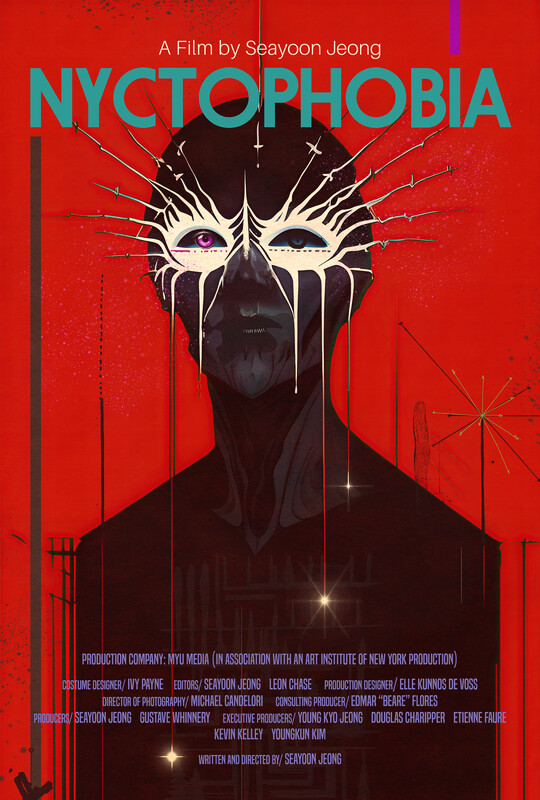
As Liz struggles with nyctophobia (fear of the dark), a form of anxiety disorder that causes sleeping issues, she desperately tries to fall asleep by entering her “inner world” where she can access her happy childhood memories. However, she ultimately becomes trapped in a time loop of sorts in her “lucid dream” world and encounters her nightmare, Dark Figure, who appears in various forms and shapes as a clown. The time loop pushes her deeper into her lucid dream world, forcing her to reach her subconscious world where she meets her worst nightmare, the original form of Dark Figure.
https://nyctophobiafearofthedark.com/
https://www.facebook.com/profile.php?id=61558600417261
https://www.instagram.com/film_nyctophobia/following/
Watch the Audience Feedback Video:
https://youtu.be/yc8lIBS4D84
Director Statement
Two years ago, when the world was hit by the covid pandemic, I endured the lock down in New York City where covid hit the hardest in the U.S. Although many people couldn’t travel or see their family because of the lockdowns, I was fortunate to have my family staying with me, so I had a support system by my side. However, whenever I tuned into local news, all I saw was covid’s relentless devastation, especially on the elderly and even younger generations. The number of dead bodies being taken care of by city and Red Cross workers constantly increased, along with the number of homeless people occupying empty streets without any protection from covid. The pandemic was as confusing and apprehensive to me as to many others, mostly due to the unknown of the future.
During this period, I suffered from extreme fear of the dark known as nyctophobia, a type of anxiety disorder, caused by stress, which eventually triggered sleeping issues. When I was little, I used to suffer from this same anxiety disorder, nyctophobia, that led to insomnia and sleep paralysis as I felt scared of the dark. Stress exacerbated the condition, but I grew out of it as I got older. The pandemic triggered it for the first time since then, disrupting my sleeping patterns for many nights. I wondered how many people were in the same boat, so I did some research on my own and found out that a large proportion of the world’s population was dealing with anxiety disorders that disrupt sleeping patterns in one way or another through an association with their fears of the dark. For some reason, people—including myself—are generally not comfortable discussing anxiety disorders, not to mention sleeping issues, even though such issues can have tremendous and debilitating physical, emotional, and psychological effect on their daily lives. Therefore, I wanted to explore this subject matter, nyctophobia, based on my own personal experience with a humble desire to represent a community of people who have sleeping issues caused by nyctophobia.
From the beginning, I wanted this project, Nyctophobia, to be a feature experimental film to ensure that I’d have more creative room for the narrative without any dialogue while examining the damaging effects of sleeping issues stemming from nyctophobia on the main protagonist, Liz. To better convey the emotional and psychological struggles of Liz whose sole purpose at night is to just fall asleep deeply, I built four realms in the story: a) Liz’s reality, b) her “inner world” where she re-creates her happy childhood memories to calm her mind and soul, c) her “lucid dream” world where she’s trapped in a time loop of sorts and encounters her nightmare, Dark Figure, who appears as a clown but in different forms and shapes, d) her “subconscious world” where she meets the original form of Dark Figure who physically attacks her. As the time loop pushes Liz deeper into her lucid dream world, she reaches her subconscious world and meets her worst nightmare, the original Dark Figure. Her lucid dream world and her reality eventually collide, blurring the lines between them, leaving her unable to differentiate between her dream where she is being attacked by the original Dark Figure and her reality where she suffers from sleep paralysis.
To distinguish the aforementioned worlds visually, Liz’s reality is expressed in black and white, while her inner world is a mix of high contrast black and white and pastel colors to show her happy childhood memories in technicolor. Meanwhile, her lucid dream world is depicted in more intense black and white that resembles the tone of “The Lighthouse” with the isolated color, red, to illustrate a sense of discomfort and danger. Also, her subconscious world and the blending of the three worlds – her reality, lucid dream and subconscious worlds – occur in extremely low-key black and white to effectively represent Liz’s fear and terror.
As the story ends early in the morning with Liz being exhausted due to getting only a few hours of sleep, all the lights in her house are on, it demonstrates the grim and damaging effects the symptoms of nyctophobia are having on her quality of life. By drawing upon my own experiences, I hope to accurately represent a community of people who struggle with the same (or similar) issues as Liz and highlight the importance of addressing the issues and seeking help if necessary to improve their quality of life instead of trying to deal with it all on their own.

 FEEDBACK Female Film Festival